Lucy schiet Mike Morales neer
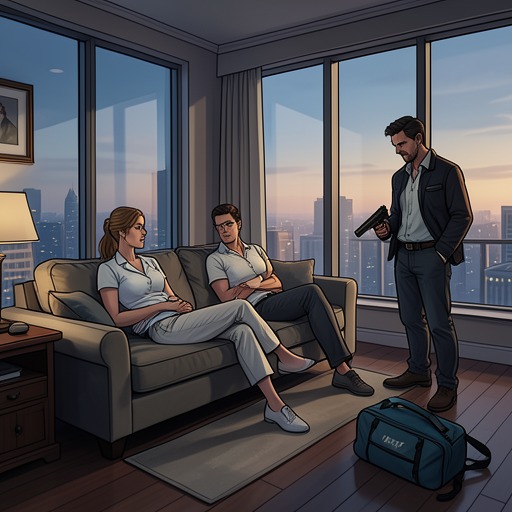
Kay ScarpettaLucy schiet Mike Morales neer is the decisive reversal of the hostage crisis: Mike Morales is poised to kill Pete Marino and Kay Scarpetta, but a gunshot from the gallery drops him before he can carry out the threat. The apparent victory is immediately complicated by Lucy’s severe head wound, the blood-soaked scene, and Pete Marino’s deliberate alteration of the evidence. The event therefore resolves the physical confrontation while opening a final question about truth, loyalty, and the boundaries of forensic procedure.
Causes and Background
The confrontation takes place after Mike Morales has turned the household into a controlled killing ground. Pete Marino believes that Morales has already killed Lucy and intends to kill the remaining hostages as well. Marino’s judgment is shaped by the danger of the moment, but also by the knowledge that Morales is a serial killer: earlier, when Marino found a dark figure lying on a roof with a revolver, he initially mistook Morales for the murderer he was pursuing. Morales’s presence in the crisis thus carries both an immediate threat and the accumulated weight of the investigation.
The larger investigation has repeatedly shown how appearances can be engineered. Oscar Bane’s shoeprints were found on the bathroom toilet lid at Eva Peebles’s home and matched the shoes he had worn when he claimed to discover Terri Bridges’s body; Oscar’s fingerprints were also found on the glass lamp used in the staged scene. Those details helped turn Oscar into a fugitive, while digital evidence later disrupted the assumption that Terri or Oscar controlled the scarpetta612 account: an unsent email had been written at 8:19 the previous evening, making it impossible for either of them to have authored it. Against this background of false identities, planted traces, and delayed recognition, the shooting is not merely an act of defense. It is another scene in which the visible evidence is immediately vulnerable to manipulation.
What Happens
A red laser dot appears on Morales’s right temple. It flickers and trembles before slowing, a tiny moving point that reveals an unseen shooter’s aim while Marino is still trying to keep Morales from killing Scarpetta. Marino says that he will put down his pistol and lowers himself into a crouch. He does not look up or behind him, and he places his Glock on the oriental rug while keeping his attention on Morales’s eyes. Morales raises his own weapon away from Scarpetta’s head and points it toward Marino, while the laser dot moves around his ear and then settles on his temple.
The shot comes from the gallery. Morales falls to the floor, and blood runs from the side of his head across the black marble. Marino takes his weapon, calls the emergency number, and goes to the kitchen. There he chooses a poultry shear from the knife block and cuts through the straps binding Scarpetta and Jaime Berger. The immediate value shift is absolute: Morales has held the power to decide who lives, and the shot removes that power in an instant. Yet the scene does not become calm. Scarpetta runs upstairs, unable at first to feel the banister, toward the person whose intervention has saved them.
Lucy lies just beyond the doorway between the gallery and the main bedroom. Blood marks her path from the bathroom across the wooden floor to the place where she shot Morales, and the .40 Glock lies beside her. She is leaning against the wall, trembling, with a towel across her lap. The amount of blood initially prevents Scarpetta from identifying the injury; Lucy’s hair is soaked, blood runs down her neck and bare back, and a pool has formed around her. The image reverses the presumed arrangement of victim and killer. Morales is dead, but Lucy, the shooter, appears close to death herself.
Scarpetta examines Lucy rather than accepting the visual impression of catastrophic injury. Lucy helps her locate the wound at the lower left side of the back of her head. Scarpetta pushes the bullet out while Lucy cries out, then gives the deformed, partially jacketed projectile to Berger and presses a towel against the wound. Scarpetta judges that the bullet probably has not damaged the skull. It seems to have struck Lucy’s head at an angle and lost most of its kinetic force in a very small area beneath the scalp, where the abundance of blood vessels can make a wound look worse than it is. Lucy’s pulse is rapid but not alarming, her breathing is calm, and she shows no sign of shock.
Consequences and Aftermath
Scarpetta tells Lucy that Morales is dead and that he had been about to shoot Marino and then the others. She keeps Lucy awake and prepares her for emergency treatment, including X-rays and an MRI scan. Lucy says that the injury hurts terribly but that she feels fine; she also cannot remember Morales or identify his pistol. Her confusion and pain coexist with the practical fact that she has prevented a massacre. The event consequently gives Lucy agency without romanticizing the cost of that agency: survival is secured, but it is written across her body in blood.
When the rescue team arrives, Marino removes Lucy’s magazine and places the rounds into a paper bag held open by an officer. He then tells the police that Berger opened the building’s front door for him, that he slipped toward the hostages, and that he intentionally made a sound to make Morales look up. According to the story he gives the officers, this distraction created the opportunity for Marino to shoot before Morales killed anyone. That account is false. Marino is concealing Lucy’s role and taking responsibility for the fatal shot, even though he had previously placed his Glock on the floor.
Marino’s lie also violates the ordinary demands of a crime scene. He handles Lucy’s Glock with both hands and carries it into the bathroom, doing what no one at a crime scene is supposed to do. The act is not careless confusion but protective interference: he reshapes the physical record so that Lucy will not be treated as the person who killed Morales. His earlier conduct had been organized around preserving life; afterward, his loyalty leads him to compromise evidence. The same investigation that depends on fingerprints, shoeprints, weapons, and digital timestamps ends with a conscious decision to make one crucial fact harder to prove.
Recognition and Narrative Significance
The shooting completes a pattern of revelations in which certainty is repeatedly destabilized. Oscar’s apparently overwhelming physical connection to Eva Peebles’s staged murder produced a nationwide manhunt, while the unsent scarpetta612 email demonstrated that the obvious candidates could not have controlled the account at the crucial time. Morales’s confrontation with Marino likewise turns on a misrecognition: the armed figure on the roof is not the unknown serial killer Marino imagines in that instant, but Morales himself. At the hostage scene, the laser dot first makes the unseen rescuer legible, and Lucy’s blood then makes the rescuer look like another casualty.
The event’s deepest reversal is therefore ethical as well as tactical. Morales uses a weapon and a hostage situation to impose his version of reality, demanding that others submit while he holds the power of life and death. Lucy breaks that arrangement with a single shot. Marino then answers the violence with a protective falsehood, placing personal allegiance above the integrity of the forensic record. The sequence moves from surveillance to aim, from threatened execution to sudden death, and from public evidence to private concealment.
Lucy’s shooting of Morales is consequently both climax and contradiction. It ends the killer’s immediate campaign, saves Marino and Scarpetta, and leaves Morales dead on the marble floor. At the same time, Lucy’s own injury and Marino’s fabricated account ensure that the truth of the rescue is not cleanly displayed. The scene insists that justice may depend on evidence while showing a character deliberately altering that evidence to preserve someone who acted in defense of others.